Top 10 Waterfalls in the Philippines
The Philippines is an archipelago of more than 7,600 islands, and its waterfalls reflect that variety: turquoise pools fed by highland rivers on Cebu, wide cliff-springs that push water straight out of volcanic rock on Mindanao, multi-tiered jungle cascades hidden behind 500-step descents, and rare coastal falls that drop directly onto white-sand beaches. Rainy season (June–November) maximises flow on every one of them; the drier months of December–May are easier for hiking but some falls — especially those fed by hydroelectric releases — may run at reduced flow. All ten are pinned on our interactive map.
1. Kawasan Falls, Cebu
Kawasan is arguably the Philippines' most iconic waterfall, a three-tier turquoise cascade set in a limestone gorge near Badian in southwestern Cebu. The main fall drops roughly 30 metres into a wide, mint-green pool whose colour comes from the mineral content of the spring-fed river above. You can reach the first tier by a short walk from Badian barangay — around 1 km on a well-marked trail — with bamboo-raft rides available in the pool. The second and third tiers require wading upstream or hiring a local guide.
Most visitors combine Kawasan with a full canyoneering tour that starts in Matutinao and descends the river gorge over roughly 6–8 hours, including jumps, slides, and swimming passages, finishing at the falls. Tours typically cost 1,200–1,800 PHP per person. The best light for photography hits the falls in the morning; by midday the gorge can be crowded with tour groups. The nearest town with accommodation is Badian, about 3 hours by bus from Cebu City.
2. Asik-Asik Falls, North Cotabato
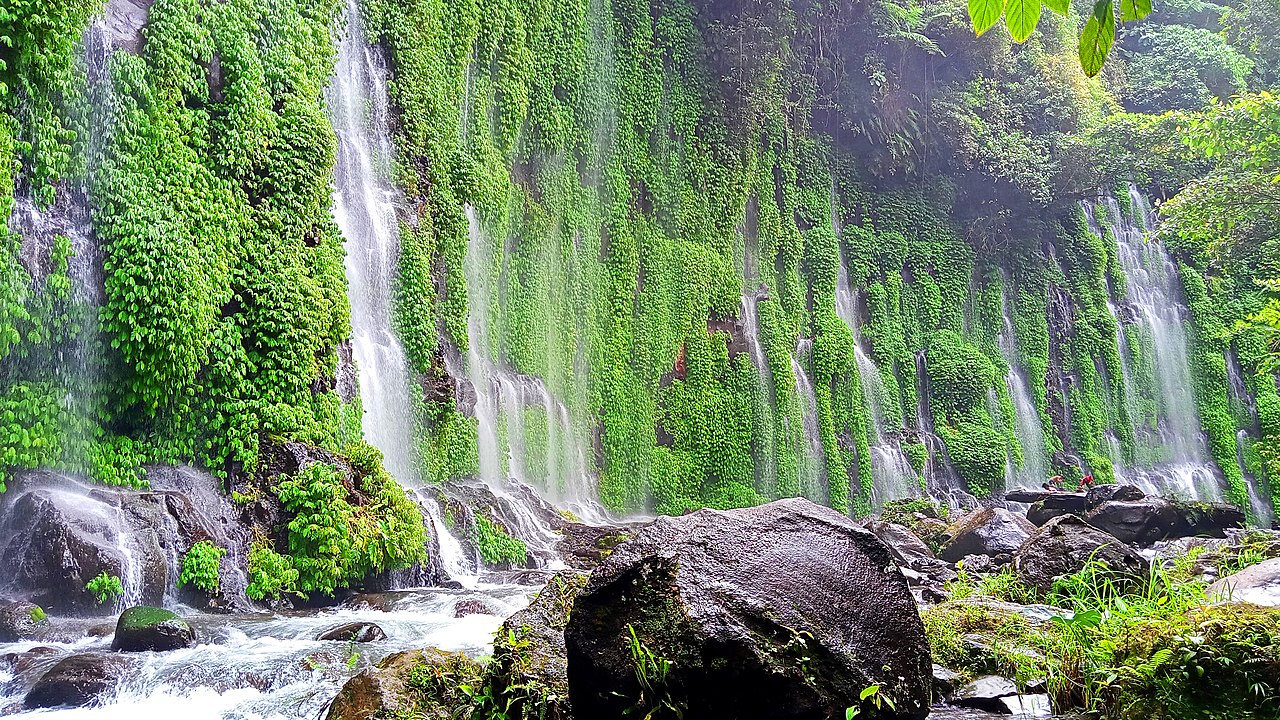
Asik-Asik is one of the world's more unusual waterfalls: rather than flowing from a river upstream, water simply emerges from a cliff face in the barangay of Datu Ladayon, Alamada, North Cotabato. The entire 140-metre-wide curtain of water seeps directly out of the volcanic rock, fed by underground aquifers in the Liguasan Marsh system. The effect is a lush, fern-draped wall of mist that feels more like a jungle grotto than a traditional waterfall.
Access involves a roughly 45-minute tricycle or habal-habal ride from Kakar proper, followed by a short walk. The falls are open daily; a modest community fee applies. Because the water source is underground, flow remains relatively consistent year-round. North Cotabato sits in central Mindanao; the nearest hub is Kidapawan City, about 2 hours south by road. The area has been peaceful for tourists for many years but it is worth checking current advisories before visiting this part of Mindanao.
3. Tinago Falls, Iligan
The name Tinago means "hidden" in Maranao, and it earns that name: the falls are reached by descending a concrete staircase of roughly 500 steps, dropping about 240 metres into a ravine. The reward is a 55-metre plunge into a deep pool that's been worn smooth into the limestone over thousands of years. Iligan City in Lanao del Norte calls itself the "City of Majestic Waterfalls" for good reason — there are more than 20 falls within the city limits — but Tinago is the standout.
The stairs can be slippery after rain, so rubber-soled shoes are advisable. At the base there are small cottages for rent and vendors selling snacks. Return is the same staircase, uphill. Allow 2–3 hours for the full visit. Iligan is reached from Cagayan de Oro (roughly 1.5 hours by bus), which has the nearest major airport with connections to Manila and Cebu.
4. Tumalog Falls, Cebu
Tumalog sits near Oslob in southern Cebu, about 30 minutes south of the whale-shark watching area at Tan-awan. It is a veil-type or horsetail waterfall — a wide curtain of water that fans out across a mossy rock face rather than plunging in a single channel. The fall drops roughly 20 metres into a generous pool suitable for swimming and wading. The mist created by the dispersed curtain keeps the surrounding vegetation permanently damp and intensely green.
Access from Oslob proper involves a habal-habal (motorcycle taxi) ride on a concrete road through coconut plantations, about 10–15 minutes. The falls tend to be quieter in the early morning before the whale-shark tours end and tourists scatter across the south. Oslob is about 3.5 hours from Cebu City by bus or van, and accommodation ranges from budget guesthouses to small resorts.
5. Pagsanjan Falls, Laguna
Pagsanjan (officially Cavinti Falls, though everyone calls it Pagsanjan) sits about 100 km south of Manila in Laguna province, making it the most accessible major waterfall from the capital. The falls drop 23 metres in twin columns into a gorge on the Pagsanjan River, also known as the Bumbungan. The experience here is as much about the journey as the destination: visitors board narrow outrigger canoes (bankas) paddled by experienced boatmen who haul the craft upstream through a series of rapids and narrow jungle-sided gorges — a round trip of roughly 4–6 km and about 1.5–2 hours depending on water levels.
Pagsanjan gained international fame as a filming location for Francis Ford Coppola's 1979 film Apocalypse Now, where the river journey was used to represent the approach to Colonel Kurtz's compound. At the falls themselves, you can board a bamboo raft to pass through a cave behind the curtain of water. The best flow is during or just after the rainy season (July–October). Entrance and boat-ride packages typically cost 700–1,200 PHP per person.
6. Maria Cristina Falls, Iligan
Maria Cristina is the most economically significant waterfall in the Philippines: its 98-metre twin-plunge on the Agus River provides a substantial share of Mindanao's electricity through the Maria Cristina hydroelectric complex. Because of this, the volume of water visible to tourists is regulated by the power company — the falls run at full capacity only on designated viewing days (typically weekends and holidays), while weekdays may show significantly reduced flow. It is worth confirming the schedule before visiting.
The falls sit just outside Iligan City; the viewing area is well-developed with a platform and landscaped park. At full flow the twin columns — separated by a rock buttress — are an impressive sight, thundering down over a green-tinged canyon. Maria Cristina is often combined with a visit to Tinago Falls on the same day trip from Iligan. Entry includes a modest national-park fee.
7. Aliwagwag Falls, Davao Oriental
Aliwagwag is the Philippines' most spectacular multi-tiered waterfall and a strong contender for its highest. The Pintatagan River drops through 84 distinct tiers over a total vertical distance of approximately 388 metres as it descends through the Aliwagwag Protected Landscape in Cateel, Davao Oriental. A series of wooden bridges and jungle trails allow visitors to explore multiple levels; a skybridge and a zipline add adventure options above the canopy.
Because Davao Oriental is relatively remote — Cateel is about 5 hours from Davao City by road over mountain highways — the falls see far fewer tourists than Kawasan or Pagsanjan, which adds to their appeal. The surrounding forest is one of the more intact lowland rain forests remaining on Mindanao, with sightings of Philippine eagles and hornbills recorded in the area. Flow is best from August through November. A community-run fee and guide service operates at the trailhead.
8. Camayan Falls, Pampanga
Camayan is unusual among Philippine waterfalls because the water is warm: it is fed by a hot spring on the flanks of Mount Pinatubo in Pampanga province, Luzon. The waterfall itself is modest in height but the setting — lahar-grey badlands left by the 1991 Pinatubo eruption giving way to green regrowth — is striking. Most visitors combine a Pinatubo crater hike (a 4WD jeepney ride followed by a roughly 2-hour hike to the crater lake) with a visit to Camayan on the way back.
The base for this area is Capas in Tarlac, about 2 hours north of Manila. 4WD tours into the lahar plain depart from Santa Juliana barangay and are the only practical way to reach the waterfall. Tours cost around 1,500–2,500 PHP per person including the vehicle and guide. Because the crater area is accessed by crossing lahar rivers that can rise rapidly, tours are cancelled during heavy rain.
9. Lulugayan Falls, Samar
Lulugayan sits on the Calbiga River in Samar, the large island province east of Leyte in the Visayas. It is a wide, multi-cascade waterfall — several separate channels descend over a broad rock shelf — which has earned it the nickname "the Philippine Niagara" for its horizontal spread rather than any particular height. The width across the main rock shelf can reach 70 metres or more at peak flow during the rainy season.
Calbiga town is the access point; from there a habal-habal or bangka boat ride reaches the falls, depending on water levels. Samar remains one of the less-visited provinces in the Visayas, meaning Lulugayan sees relatively light tourist traffic even though it is genuinely impressive. The island is reached by bus and ferry from Tacloban in Leyte, or overland from Manila via Sorsogon and the San Isidro–Allen ferry crossing.
10. Sambawan Island Falls, Biliran
Biliran is a small island province linked to Leyte by bridge, and it contains a waterfall that is genuinely rare: one that drops directly onto a beach. Sambawan Island Falls (sometimes listed as falls near Naval or within the Biliran island group more broadly) cascade down a rocky cliff face and land on sand or rocks at the tideline. The combination of jungle, black-sand beach, and freshwater spray in one frame makes it a favourite of photographers.
Naval is the capital of Biliran and the practical base; boat hire from Naval or nearby barangays allows access. The falls are best visited at low tide when the beach is exposed. Flow peaks in the rainy season (July–November), when the cascade is at its most dramatic. Biliran is small enough that you can combine the waterfall with other island attractions — including hot springs at Mainit and the rice terraces of Cabucgayan — in a single day.
Planning Your Visit
Most of these falls are most dramatic from July through October, when the southwest monsoon (habagat) fills the rivers. Travelling in the dry season (January–May) means easier road access, lower humidity on the trails, and no risk of flash flooding — but some falls will be noticeably thinner. For any fall in Mindanao (Asik-Asik, Tinago, Maria Cristina, Aliwagwag), check government travel advisories for the specific province before going. For all falls, rubber sandals or water shoes and a dry bag for electronics are the two most practical items to carry. All ten are pinned on our interactive map.